
Planning a new garden, laying sod, or putting up a fence starts with one crucial step: knowing the size of your space. Figuring out how to measure yard dimensions accurately is the foundation of any successful outdoor project. It helps you buy the right amount of materials, saving you from overspending or making extra trips to the store.
This process might seem complex, especially if your yard has an irregular shape, but it’s simpler than you think. This guide will provide clear, easy-to-follow instructions to help you calculate your yard’s square footage like a pro, ensuring your next project gets off to a perfect start.
Measuring your yard accurately begins with understanding your space and breaking it down into manageable sections. Whether it’s a rectangle, circle, or an irregular shape, approaching the task step by step will make the process straightforward.
With just a few basic tools and some simple calculations, you’ll be able to determine the precise measurements needed for your project.
Why Proper Yard Measurement Matters
Accurate yard measurements are essential for almost any landscaping or gardening endeavor.
When you know the precise square footage of your lawn, you can calculate the exact amount of fertilizer, grass seed, or mulch needed, preventing waste and ensuring healthier plants. For larger projects like installing a patio, sprinkler system, or new sod, incorrect measurements can be costly.
Buying too much material leads to unnecessary expense, while not buying enough causes frustrating delays. A proper measurement gives you the confidence to create detailed plans, get accurate quotes from contractors, and budget effectively, setting the stage for a smooth and successful project.
Step-by-Step Guide to How to Measure Yard
This detailed guide will help you determine your yard’s area, whether it’s a simple rectangle or a more complex shape with curves and obstacles.
Step 1: Sketch a Rough Diagram of Your Yard
Before you grab a tape measure, start with a simple sketch of your property. Don’t worry about making it perfectly to scale; this is just a visual aid. Stand in a central location and draw the basic outline of your yard, including the house, driveway, walkways, and any other large, permanent features like sheds or large garden beds.

This bird’s-eye view will help you visualize the area and break it down into smaller, manageable geometric shapes. This initial map is your roadmap for the entire measurement process, making it much easier to keep track of your calculations.
Step 2: Gather Your Measurement Tools
For this task, you will need a few basic tools. A long tape measure, preferably 50 or 100 feet, is ideal for covering large distances accurately. If you don’t have one, a standard 25-foot tape measure will work, but it will require more patience.
You will also need a notepad and pen or your phone’s notes app to jot down measurements as you go. Lastly, having stakes or flags can be very helpful for marking the corners of the shapes you’ll be measuring, especially in a large or irregularly shaped yard.
Step 3: Break Your Yard into Basic Shapes
Most yards are not perfect squares or rectangles. The key to measuring a complex space is to divide it into a combination of simple geometric shapes like squares, rectangles, triangles, and circles. Look at your sketch and draw lines to partition the yard into these basic forms.
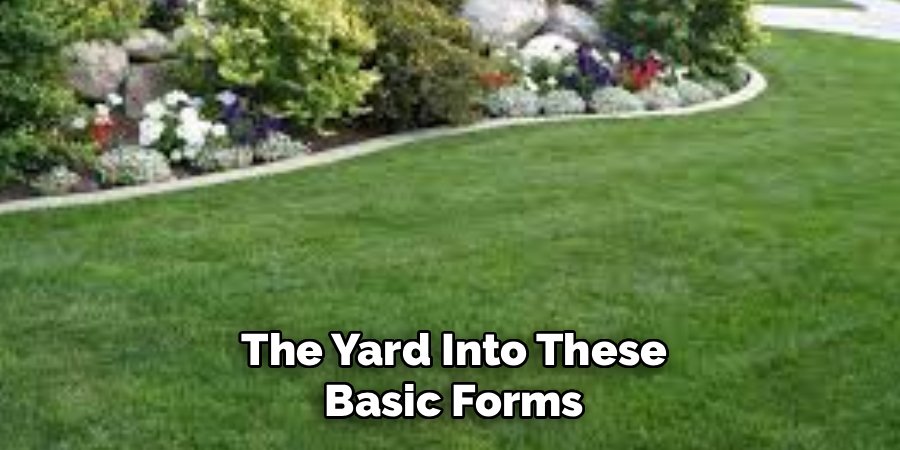
For example, a large L-shaped area can be split into two rectangles. A curved flower bed can be treated as a semi-circle or a series of small triangles. This method simplifies the math and ensures every part of your yard is accounted for in your final calculation.
Step 4: Measure the Length and Width of Rectangular Sections
Start with the largest and easiest sections to measure: the rectangles and squares. For each rectangular area you identified on your sketch, use your tape measure to find the length and the width. It is helpful to have a second person to hold the other end of the tape measure to ensure it is straight and taut for an accurate reading.
Record these two numbers for each rectangular section in your notepad. To calculate the area of that section, you will multiply the length by the width. For example, a section that is 40 feet long and 20 feet wide has an area of 800 square feet.
Step 5: Measure Triangular and Circular Areas
For triangular sections, measure the base and the height. The height is the distance from the base to the opposite corner, measured at a 90-degree angle from the base. The area is calculated by multiplying the base by the height and then dividing by two. For circular or semi-circular areas, like a curved patio or pond, measure the radius.

This is the distance from the center of the circle to its edge. The area of a full circle is found using the formula πr² (pi times the radius squared), where π is approximately 3.14. For a semi-circle, just divide that result by two.
Step 6: Use an Online Tool for a Quick Method
If manual measurement seems too tedious, modern technology offers a convenient shortcut. There are numerous free online tools and mobile apps that use satellite imagery to measure your property.
Websites like Google Maps have a built-in measurement tool that allows you to click on the perimeter of your yard to calculate the area. Similarly, specialized landscaping apps can provide highly accurate readings.
While these tools are incredibly helpful for getting a quick estimate, it is still a good idea to take a few manual measurements to verify their accuracy, especially for projects requiring precise material orders.
Step 7: Calculate the Total Square Footage
Once you have measured all the individual shapes that make up your yard, it’s time to do the final math. Go back to your notepad where you recorded the area for each section. Add the square footage of all the squares, rectangles, triangles, and circles together.

This sum will give you the total area of your yard. If you are planning a project for a specific part of your yard, like a new lawn, you will need to subtract the areas of features like your house, driveway, and patios from the total area.
Step 8: Double-Check Your Measurements
Accuracy is key, so it’s always a good practice to double-check your work. Go back and quickly re-measure a few of the key dimensions, especially for the largest sections of your yard. A small error in measuring a long side can lead to a significant miscalculation in the total area.

Also, review your calculations to make sure you didn’t make any simple arithmetic mistakes. Taking an extra ten minutes to verify your numbers can save you a lot of time, money, and frustration down the road when you are purchasing materials for your project.
Common Measurement Mistakes
One of the most common measurement mistakes is not accounting for irregularities in the shape of the area being measured. For example, assuming a yard is perfectly rectangular when it has uneven edges can result in inaccurate dimensions.
Another frequent error occurs when skipping the use of proper tools, such as measuring tapes or laser distance tools, and instead relying on rough estimates. Additionally, failing to measure consistently, such as measuring one side in feet and another in inches without converting, can lead to significant discrepancies.
It’s also easy to overlook small obstacles, like slopes or corners, which may require additional adjustments to your calculations. Being attentive and thorough can help ensure your measurements are as accurate as possible.
Frequently Asked Question (Faq)
What Is The Easiest Way To Measure An Irregularly Shaped Yard?
The easiest way to measure an irregularly shaped yard is to break it down into a combination of smaller, regular shapes like rectangles, squares, and triangles. Sketch your yard and draw lines to divide the space.
Measure each shape individually and then add their areas together for the total square footage. For very complex curves, using an online satellite mapping tool can provide a quick and reasonably accurate estimate.
How Do I Calculate The Square Footage Of My Lawn Only?
First, calculate the total square footage of your entire property by measuring it as a large shape. Then, measure the footprint of all the non-lawn areas, such as your house, driveway, walkways, patio, and garden beds.
Calculate the area of each of these features and add them all together. Finally, subtract this total non-lawn area from the total property area. The remaining number is the square footage of just your lawn.
Are Online Yard Measurement Tools Accurate?
Online tools that use satellite imagery, like Google Maps or specialized landscaping apps, are generally quite accurate for most home projects. They are excellent for getting a quick estimate for materials like mulch or fertilizer.
However, for projects that require precise cuts and fittings, such as installing a fence or a patio, it is always recommended to verify the online measurements with a manual tape measure to ensure complete accuracy.
How Many Square Feet Are In An Acre?
There are exactly 43,560 square feet in one acre. This is a useful conversion to know if you have a very large property.
To find out how many acres you have, you would calculate the total square footage of your yard and then divide that number by 43,560. For most residential properties, the measurement will be a fraction of an acre.
What Is A Measuring Wheel And Is It Good For Yards?
A measuring wheel, also known as a surveyor’s wheel, is a tool with a wheel at the end of a long handle that clicks to count rotations as you walk. It is an excellent and fast tool for measuring long, straight distances in a yard.
It is much easier for one person to use than a tape measure. They are particularly useful for measuring the perimeter of a property or long sections of a lawn quickly.
Conclusion
Knowing the dimensions of your yard is the first step toward transforming your outdoor space. While it may require some initial effort, the benefits of accurate measurements are undeniable. You can budget with precision, purchase the correct quantity of materials, and plan your projects with confidence.
By following these steps—sketching your layout, dividing it into simple shapes, and carefully calculating each area—you have the knowledge to tackle this task effectively. Now that you understand how to measure yard space, you are well-equipped to bring your next gardening or landscaping vision to life.

About
Jovie Mathews is a backyard and outdoor expert writer with over 12 years of hands-on experience transforming neglected outdoor spaces into thriving gardens and functional retreats. Raised in a family where weekends meant digging in the soil and building raised beds from scratch, Jovie developed a genuine love for the outdoors long before it became a career.
She writes with a practical, no-fluff approach — always testing ideas in her own backyard before sharing them with readers. From composting systems and native plant selection to patio design and pest control, Jovie covers the full spectrum of backyard life with equal parts expertise and enthusiasm.
Education
B.Sc. in Horticulture Science
University of Florida (UF) · Gainesville, FL · 2014
IFAS College of Agricultural and Life Sciences
Minor in Environmental Studies
University of Florida (UF) · Gainesville, FL · 2014
College of Liberal Arts and Sciences
Areas of expertise
- Lawn & Garden Care
- Soil prep, planting, seasonal care
- Outdoor DIY Projects
- Raised beds, fencing, pathways
- Composting & Soil Health
- Organic methods, amendments
- Native Plants & Wildlife
- Pollinators, habitat gardening
When she is not writing, Jovie can be found testing new composting techniques, growing tomatoes in questionable quantities, or convincing her neighbors that clover lawns are actually a great idea. She currently gardens in the Pacific Northwest.